

CargoFusion, the package dimensioning app for a smartphone
CargoFusion is a package dimensioning app that runs on an ordinary smartphone. The camera captures the length, width and height of a package, a second step reads the carrier label, and the system compares the two so a dimensional weight discrepancy is flagged before the shipment is submitted. It is made for freight forwarders and third-party logistics teams.
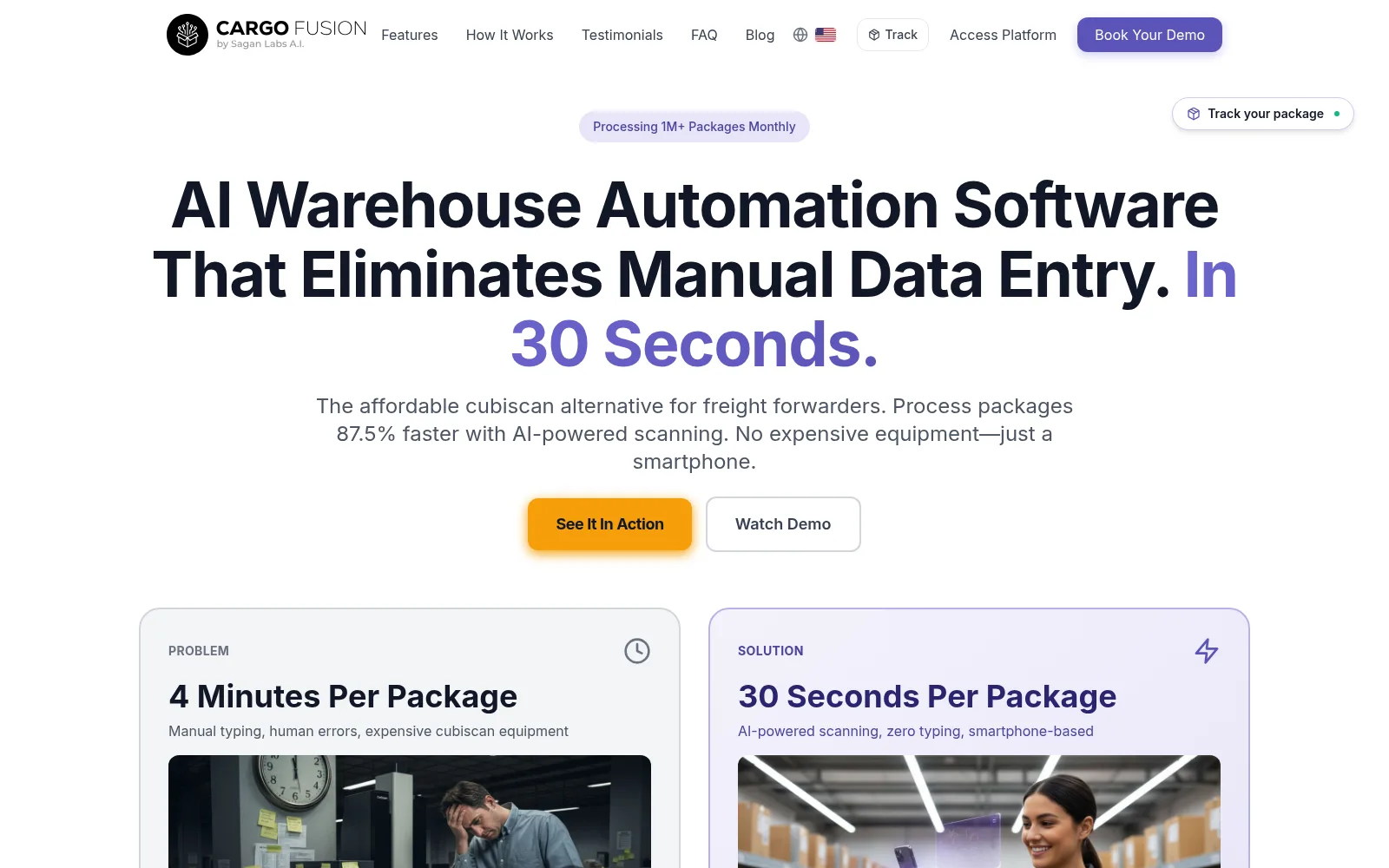
How the CargoFusion dimensioning app works at the dock
The workflow has three moves, in this order, and it is designed to be simple for a new operator to learn.
Scan
The operator points the phone at the package. An augmented reality box appears around it and captures length, width and height.
Verify
The app reads the carrier label and extracts the tracking number, the recipient and the stated dimensional weight, then compares that figure with the measured box.
Submit
If the numbers agree, the operator submits. If they differ, the discrepancy is shown first, while the package is still in hand.
Who CargoFusion is for
CargoFusion is for freight forwarders and third-party logistics operations that measure packages every day. The usual choices are a fixed dimensioning machine that only works where it is installed, or a tape measure and a keyboard. CargoFusion puts the measurement on the device a warehouse worker already carries.
The product is available in English, Portuguese and Spanish, and it is designed to sit alongside the carrier relationships a forwarder already has.
What the product shows about our computer vision work
Two specialized steps, one answer
One model measures the object and another reads the label. Each is tuned to a narrow job, and the product cross-references them.
Built for the real floor
The capture happens through the phone camera with an overlay the operator can see, so the person knows what was measured.
A check before submission
The comparison between measured size and printed weight happens before submission, where a correction is cheap.
The same pattern for your operation
Our computer vision service applies this approach to other physical checks: a camera reads the scene, a second source states what should be true, and the difference goes to a person.
Where the operator decides
CargoFusion measures and compares. The person holding the package keeps the final say.
- The operator sees the augmented reality box on screen as the dimensions are captured.
- A mismatch between the measured package and the label is flagged for the operator before submission.
- Submission is a step the operator takes after the check.
Questions people ask
Does CargoFusion need special hardware?
No. It runs on an ordinary smartphone and uses the camera. The product exists so that a forwarder can measure packages without a fixed dimensioning machine installed at each site. The operator points the phone at the package and the app captures length, width and height.
What does CargoFusion read from the carrier label?
It reads the tracking number, the recipient and the stated dimensional weight. That stated weight is then compared with what the camera measured. When the two disagree, the app shows the discrepancy before the shipment is submitted, so the correction happens at the dock.
Who uses CargoFusion?
Freight forwarders and third-party logistics teams use it. The typical user is a warehouse operator who measures many packages in a shift and needs a quick, consistent check that the box in hand matches the label on it. The interface is available in English, Portuguese and Spanish.
What is the price of CargoFusion?
We do not publish a CargoFusion price here. Contact the product team through cargofusion.ai for its terms. If you want a custom vision system for a different physical check, every project is scoped individually; the price depends on the objects, the environment, the cameras and the systems it must update. Book a call for a quote.
Can you build a camera-based check for something other than packages?
Yes. Measuring, counting and verifying physical items with a camera is the core of our computer vision service. We start with photos taken in your real conditions, define what a correct result looks like and decide which cases go to a person. Lighting, angles and camera quality all shape the design.
Keep exploring
Tell us what you want to build
Pick the way that suits you. A person replies, and the first conversation is about your work, not a sales script.